The hand of the Lord feeds us, He answers all our needs
by Fr. Jerome Cayetano | 08/02/2026 | The WORD in other wordsOur Sunday readings today point to one theme, that is, we have a God who is our Father who provides us with abundant blessings and graces because of his profound unconditional love for us. He reassures us that he never abandons us. His presence and care are constant, and he invites us to be an extension, a concrete and tangible expression of his provident love to our brothers and sisters in need.
In the first reading, Prophet Isaiah expresses the open invitation from God when he says: “All you who are thirsty, come to the water.” It is an image God’s abundance which is freely given to us and we cannot even earn with our merits. The picture of water, wine and milk signifies the essentials of our needs and the bounty of God’s generosity. In hunger and in thirst, God invites us to come to him and be satiated by his blessings. We are just appalled and overwhelmed by his generosity which at times is beyond our understanding.
In the second reading, St. Paul poses an existential question: “Who can separate us from the love of Christ?” Will this be our anguish, or distress or persecution, or famine, or nakedness, or peril, or the sword?” He answers us with these consoling words: “Nothing can separate us from God’s love in Christ Jesus our Lord…” He continues: “Neither death, not life, nor angels, nor principalities, nor present things, nor future things, nor powers, nor height, nor depth, nor any creature…” can separate us from God’s love for His love is constant, unchanging, and eternal.
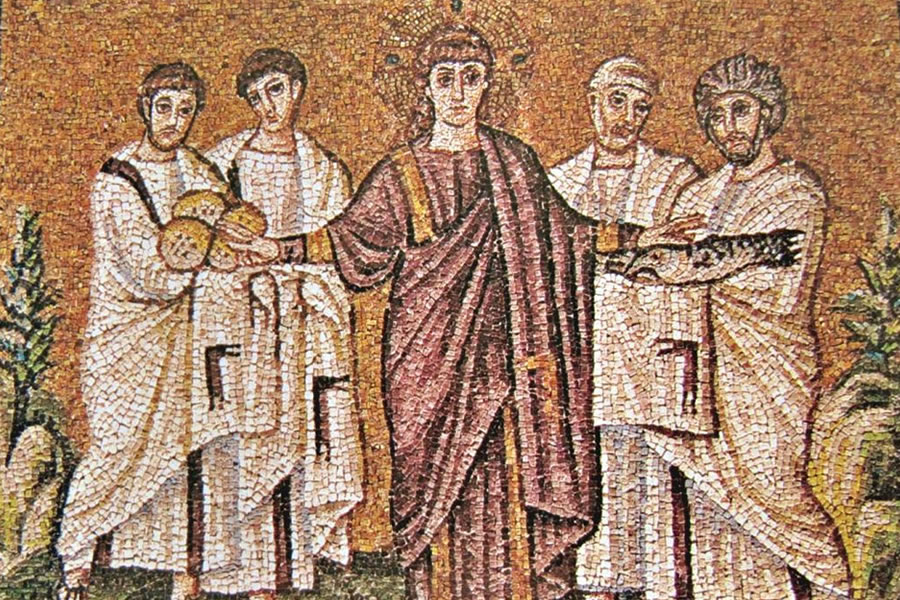
Today, we hear the story of the multiplication of the bread and the fish in the Gospel of Matthew. By the way, all the gospels have this story. It shows that the first early Christian community gives so much importance to it because of its Eucharistic underpinnings. Each story is different depending on the teaching it would like to stress and bring about. Nevertheless, it is because of Jesus’ great compassion for the crowd that moved Him to feed the five thousand men, excluding the women and children. In contrast, the disciples were unmoved and insensitive to the feelings of the crowd. They even suggested to Jesus to send them away when they said: “This is a deserted place, and it is already late; dismiss the crowds so that they can go to the villages and buy food for themselves.” Jesus insisted: “There is no need for them to go away, give them some food yourselves.” In other words, Jesus wanted them to overcome their selfish attitude and begin to show empathy by sharing what they have. Again, they complain: “Five loaves and two fish are all we have.” Despite their meager provision, Jesus told them to bring them to Him and ordered the crowd to sit down on the grass. Jesus, the Good Shepherd, is now about to feed His sheep. But first, He took the bread and fish, said the blessing, broke the loaves, and gave them to the disciples, who in turn gave them to the crowd. These are Eucharistic actions that Jesus would do again at the Last Supper.
Jesus is teaching, inspiring and convicting each one of us to imitate his attitude to those who are in need. According to statistics, there are 266 million people who are hungry in our world today. Why is this happening? Because people have remained apathetic and indifferent to the needs of others. They have forgotten the power to share their blessings, even in their meager resources. Selfishness, greediness, and the indifference of people are the root cause of hunger in the world and around us. If all people had the same compassion, sensitivity and proactive mentality as Jesus, I am sure we could really make the difference. Mind you, we are all instruments of God’s providence and blessings.
We should not belittle the power of sharing. Jesus was able to multiply the five loaves and two fish because the disciples were able to share their meager resources. God would also be able to feed millions of people if rich nations would begin to share their resources with the poor ones. Even our meager resources should not prevent us from reaching out to others. No one is too poor to share. We can share our time, talent and treasure with others.
Finally, the Lord is teaching us not to waste our resources. He told the disciples to gather the fragments left over. One of the things that I have observed here in our country - there is so much waste…We waste a lot of food. Personally, I have learned to eat what is left over…though it is always nice to eat what is fresh.
BACK TO LIST